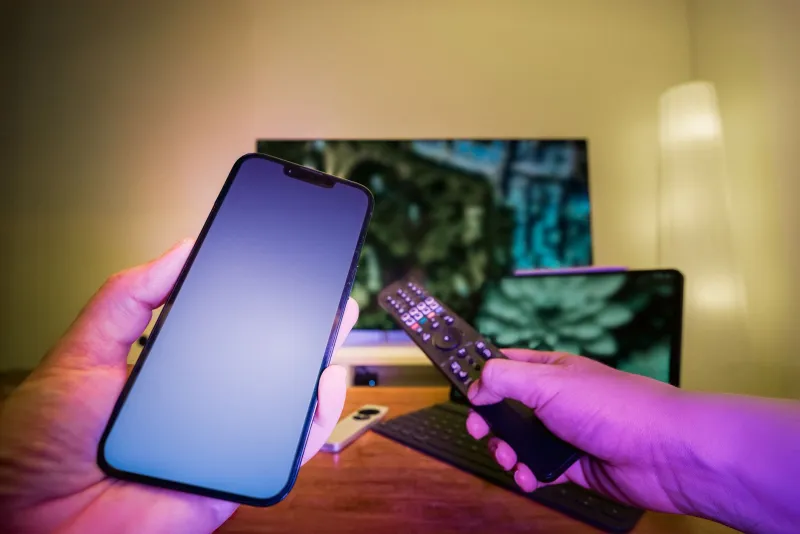
The Telly Is On, But Nobody’s Home: Britain’s Half-Watching Habit
Photo: David Hiser, Public domain, via Wikimedia Commons
There is a very specific sound in British homes at around 8pm. It is not the opening credits of a shiny new drama, nor the hush before a big reveal. It is the low, familiar hum of a sitcom you have seen fourteen times, playing to a room where nobody is actually looking at the screen.
The comfort watch has become the comfort listen. We are not settling down to watch telly so much as switching it on to keep us company. The box set is no longer an event; it is wallpaper with a laugh track.
This is not a moral panic about phones. It is a genuine shift in how telly works in daily life. And it raises an awkward question: if we are only half-watching, what exactly are we asking television to do?
The rise of the background box set
Think about your own living room. Maybe it is Peep Show while you chop onions. Friends while you scroll through nonsense. The Office while you fold the washing. Gavin & Stacey while you wait for a takeaway. The show is not the main event. It is the atmosphere.
Streaming services have made this almost too easy. Autoplay rolls into the next episode. The catalogue is deep enough to provide an endless loop of familiar favourites. You do not have to choose, decide or concentrate. You just press play and let the telly do its thing in the corner.
In many homes, the television has become a sort of audio companion with occasional pictures. We can quote the lines before they happen. We know when the good bit is coming. We do not need to look up because we already know what it looks like. It is a podcast with a visual memory attached.
And honestly? It makes sense. After a day of emails, group chats, headlines and tiny domestic admin tasks, the idea of committing to a new prestige drama feels less like relaxation and more like homework.
Familiarity is doing a lot of heavy lifting
New telly demands things. It asks you to learn names, follow timelines, read subtitles, remember who betrayed whom in episode two. It wants your full attention and it often wants it for six hours.
A comfort show asks for nothing. That is the appeal. It is the televisual equivalent of putting on a pair of old joggers. No stakes, no surprises, no risk of accidentally starting a show that turns out to be stressful.
There is also a social layer to it. Familiar telly is safe telly. You can have it on while other people are in the room without needing to negotiate what to watch. You can leave it running while you cook, clean or answer messages. It fills the silence without demanding a response.
In a way, the telly has become a radiator. You notice when it is off. It makes the room feel less empty. But you would not say you are actively watching the radiator.
What happens when nobody is looking?
This is where it gets interesting for anyone who cares about storytelling. Television is a visual medium. Writers, directors and performers build jokes, tension and emotion through framing, timing, faces and tiny details. If a big chunk of the audience is only listening, some of that craft is being lost in the ether.
You can already see the drift in shows that are easy to half-follow. Dialogue does more work. Plots are explained a little more clearly. Visual gags still exist, but they are not always the point. The medium starts writing for ears as much as eyes.
That is not automatically a disaster. Radio has been doing brilliant things with audio for a century. But telly is not radio. When a show is designed to be ambient, it can start to feel like background music with a plot. The danger is not that we are all too distracted to understand complex stories. The danger is that commissioners start expecting distraction and build for it.
We could end up with more telly that is pleasant to have on, but harder to remember afterwards. The kind of show you finish and describe as “nice” before immediately forgetting the ending.
The watercooler gets quieter
There is a cultural cost too. Half-watching is fine for the individual, but it makes shared conversation harder. You cannot really debate a twist you half-heard while unloading the dishwasher. You cannot argue about a character’s motives if you were looking at your phone during the scene that explained them.
Instead, telly becomes a shared ambient reference rather than a shared text. We all know the show is on. We all know the theme tune. But fewer of us are actually inside the story together.
That does not mean conversation disappears. It just changes. We talk about the vibe, the cast, the fact that it is back, the fact that it is not as good as it used to be. It is a bit like discussing a podcast you had on in the car: you caught the shape of it, but not the detail.
Can we reclaim the full stare?
This is not a call to bin the comfort telly. There is a place for a familiar show humming away while life happens. Nobody needs to be lectured about attention spans by a website. We are all guilty of it.
But there is something worth protecting about giving a show your actual eyes. Not every night. Not every episode. Just sometimes. Phone in another room. Laptop closed. A proper cup of tea. Lights off. Let the telly be the main event rather than the soundtrack to folding socks.
Because the odd thing is that when you do give a show twenty minutes of full attention, it often rewards you. Jokes land harder. Performances register. You notice the stuff you missed the first eleven times you had it on in the background.
Ambient TV is not the enemy. It is a sign of how comfortable telly has become in our lives. But comfort can tip into autopilot. And if nobody is ever really watching, we might eventually forget why we fell for the box in the corner in the first place.
The telly can be company. Just occasionally, let it be the conversation too.