We’ve Got Nothing to Talk About: How the Box Set Killed the Monday Morning Theory

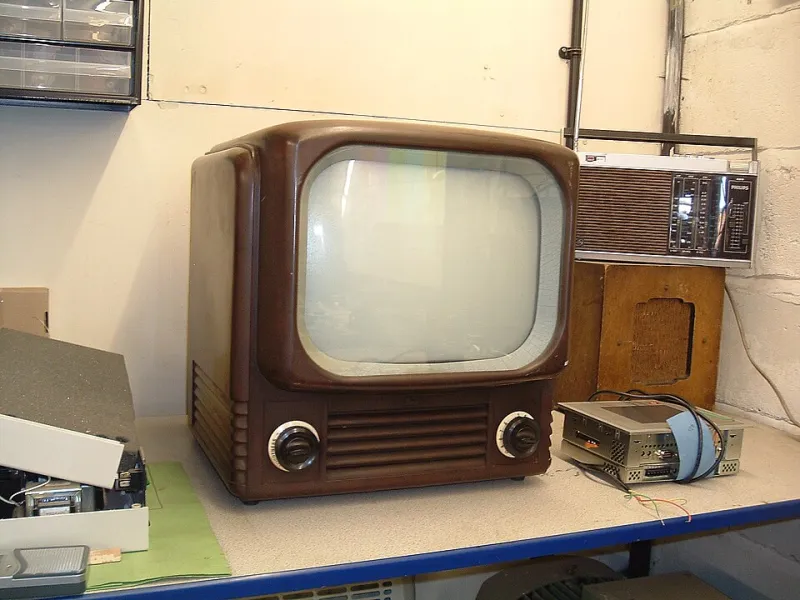
Photo: Florida Memory, No restrictions, via Wikimedia Commons
Remember when a British telly episode could end on a look, a gunshot, or a door left ominously ajar, and the entire country had to sit with it for seven days? Same time next week, same sofa, same low-level dread. That was the deal. The cliffhanger was not just a plot device; it was a social contract. It said: we will all be here on Monday, and we will all have questions.
Now the credits roll and the algorithm has already started counting down to the next episode. The cliffhanger has not vanished exactly. It has been compressed, auto-played and swallowed whole by the box set. And with it has gone one of telly’s most underrated pleasures: the Monday morning theory.
The duff-duff was a social contract
Think of the great British endings. EastEnders loves a duff-duff that lands like a dropped tray in a caff. Doctor Who used to leave children staring at a wall for a week. Line of Duty turned ‘who is H?’ into a national workplace argument. Bodyguard had half the country gripped by a sniper and a briefcase. These weren’t just twists. They were scheduling. They gave us something to do between episodes: speculate, argue, text your mum, accuse a colleague of having dodgy theories.
Weekly telly created a shared window. Everyone was at the same point in the story, more or less. The watercooler did not need a spoiler warning. It needed a brew and a firmly held belief that the nice one was definitely the killer.
Streaming made telly a solo sport
Then came the full-season drop, and telly became a private hobby with a public spoiler problem. You finish six episodes on a Tuesday night. Your mate is on episode two. Your group chat becomes a minefield of ‘no spoilers’ and passive-aggressive thumbs up. The conversation doesn’t disappear, but it splinters. The shared theory becomes a solo binge, and the cliffhanger becomes a ‘next episode starts in five seconds’ countdown.
The ‘previously on’ recap has suffered too. Once it was a mini-drama in itself: dramatic drums, a meaningful look, a reminder that someone had a secret brother. Now it is often a skip button. When you have watched four episodes back to back, you do not need reminding what happened. You need a lie down.
The recap was an art form
There is a reason the recap used to feel like a treat. It assumed a week had passed and real life had got in the way. It was telly’s way of saying: don’t worry, we’ve got you. In the streaming age, that reassurance can feel like admin. Why spend ninety seconds on a recap when the audience is mainlining the whole series like a bag of Monster Munch?
But the recap was doing more than plot maintenance. It was setting the mood. It was a reset button, a little ritual before the next helping. Losing it is a small thing, but small things add up. The weekly model gave us rituals: the Sunday night drama, the ‘one more episode’ lie, the group chat post-mortem. Streaming gives us convenience, and convenience is lovely, but it rarely gives us a national conversation.
Weekly release is creeping back
Here’s the twist nobody ordered: weekly release is having a bit of a moment. Streamers that once dumped whole seasons now parcel out episodes like a careful parent with the Quality Street. The Traitors has shown how a weekly schedule can turn a show into an event. BBC dramas still understand the power of a Saturday night slot. Even the big streamers have noticed that a weekly drop keeps a show in the cultural oxygen for longer.
That is not just nostalgia. It is economics with a side of ego. A weekly show gets headlines for weeks. A full drop gets a weekend of discourse and then a hundred new things to watch. The cliffhanger is a marketing tool as much as a storytelling one.
But weekly release is not automatically noble. Some shows stretch a thin plot across eight weeks like butter over too much toast. A cliffhanger only works if the next episode is worth the wait. Otherwise it is not suspense; it is a hostage situation.
What we lost, and what we could get back
The death of the cliffhanger is not a tragedy in every case. Some twists were daft. Some recaps were filler. Some weekly schedules kept us waiting for episodes that did not deserve the anticipation. But we have lost something real: the collective pause. The week-long ‘what did that mean?’ The pub debate. The office theory that is immediately proven wrong.
In 2026, telly is everywhere and nowhere at once. We can watch anything, any time, on any screen. But a show that makes us wait, and gives us something worth waiting for, can still cut through. The cliffhanger is not dead. It is just waiting to be scheduled properly.
So maybe the comeback is not about going back to a single weekly slot for everything. It is about choosing the right shows for the right release. Give us the event. Give us the recap. Give us a week to argue about it. And for goodness’ sake, give us a decent duff-duff.