The Reactor Is the New Remote: Britain’s Second-Hand Telly Habit
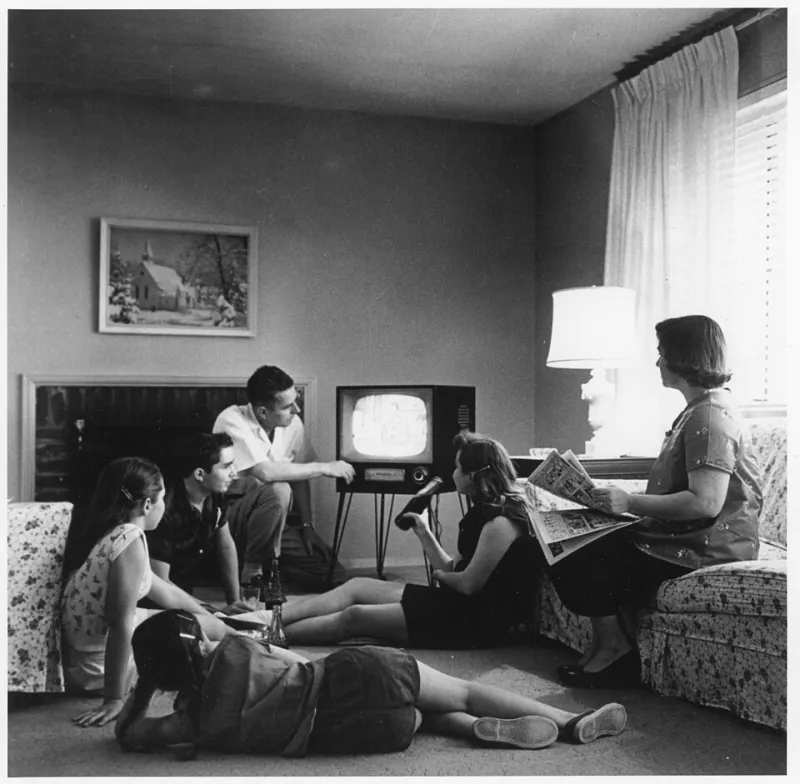
Photo: Evert F. Baumgardner, Public domain, via Wikimedia Commons
It is a Tuesday night in November. The kettle’s on, the good biscuit tin is open, and you have finally carved out forty-five minutes to watch the telly you have been meaning to watch since Sunday. And then you open YouTube and watch a stranger in a hoodie watch it instead. He gasps. You nod. He says “no way” three times in a row. You take a sip of tea. The episode is playing somewhere in a small window in the corner, but the main event is the man’s face.
This is not a niche habit any more. It is a full-blown viewing strategy. Search “Bake Off reaction” or “Line of Duty first time watching” and you will find an ecosystem: earnest Americans discovering that British telly has regional accents, TikTokkers cutting a 58-minute drama into 40 seconds of pure jaw-drop, and channels with a million subscribers whose entire business model is being surprised on camera. We are no longer just watching telly. We are watching people watching telly, and increasingly we are doing it first.
The ancestor nobody wants to mention
The obvious comparison is Gogglebox, which has been putting ordinary people on sofas since 2013 and remains one of the most reliable hours on British screens. But Gogglebox is a group activity: it is warm, it is communal, and crucially it is funny because of the people, not because of the show. The new reactor economy flips that. It is one person, a ring light, and a thumbnail with an exaggerated open mouth. The sofa has become a set. The living room has become a stage.
And yet the impulse is identical. We have always liked watching telly with someone. What has changed is that the someone no longer needs to be in the room, or even on the same continent, or awake at the same time as us.
The spoiler paradox
Here is the strange bit. People are watching reactions to episodes they have not seen. Not recaps, not reviews — full-on first-time reactions, spoilers and all. On paper this is madness. In practice it is a taster menu. A two-minute clip of someone losing their mind at a twist is enough to convince you to commit to eight hours of a police procedural you had previously described as “not really my thing”.
The result is a bizarre new spoiler etiquette. The old rule was simple: don’t tell anyone who dies. The new rule is: it depends whether you plan to watch the reaction first. Group chats have splintered into factions — those who watched live, those who watched the reactor watch it, and those who are waiting for the reactor’s second channel to upload the extended cut. Nobody knows what counts as a spoiler any more. We have invented a new way to ruin telly for each other and we are calling it content.
The loneliness of the long-distance streamer
There is a reason this works, and it is not just the algorithm. Telly has become intensely private. We watch on laptops, on phones, on three different streaming apps with three different passwords. The office watercooler, that great engine of British small talk, has been replaced by a group chat that dies at 11pm. Half of us are three episodes ahead and the other half are saving it for the weekend.
Reaction channels fill that gap. They are a watercooler you can summon on demand. You get the communal gasp without having to coordinate diaries. For anyone who has ever watched a finale alone and felt slightly unhinged by the experience, there is something genuinely comforting about a stranger reacting in real time, even if the stranger is performing for an audience of two million.
The performance problem
The catch is that the reaction is now the product, and products get optimised. Faces get bigger. Gasps get louder. The pause before the verdict gets longer, because that is where the ad break goes. You can feel the gears turning: this is the moment where the creator decides whether to cry, and you can almost see them check the engagement metrics before doing it.
The result is a strange flattening. Every show produces the same reaction, because the reaction is what travels. A quiet, devastating British drama and a loud American reality show generate the same thumbnail: wide eyes, hand over mouth, “I was NOT ready”. The telly becomes raw material for a face.
What it is doing to the telly
Producers are not stupid. They can see where the clips come from. Scenes are getting more clip-able, endings more bait-y, dialogue more quotable. A show that wants to live on TikTok writes its own subtitles. That is not necessarily bad — British telly has always been good at a killer line — but there is a difference between writing for the room and writing for the reaction. When the second audience is a stranger with a ring light, the temptation is to build the show around the gasp rather than the story.
So is it communal telly, or just content about content?
A bit of both, which is the most British answer available. Reaction channels are not a replacement for watching telly together. They are a replacement for the thing that used to happen after watching telly together: the debrief. And debriefs have always been the best part. If a 22-year-old in Ohio can give us that on a Tuesday night, with the kettle on and the good biscuits out, then maybe the watercooler has not died. It has just moved, and it has started charging for memberships.
The only thing to watch is whether we eventually stop watching the shows at all. There is a version of the future where the reaction is the telly, the recap is the reaction, and the actual programme becomes a rumour. We are not there yet. But it is November, the nights are long, and somewhere a man is watching Bake Off for the first time. Pass the remote. Or don’t. It’s on in the corner anyway.